Worship
| |
Ascensiontide continues the Week of May 20
Join us for worship on Sunday or throughout the week in the Chantry Chapel The Day of Pentecost is May 27 Printable Guide for the Week of May 20 The Rector speaks about Sunday School in his audio message. |
Highlights for Eastertide, which includes Ascensiontide
Saint Thomas Church stands at the corner of Fifth Avenue and 53rd Street in the modern metropolis of New York precisely because of the events that occurred during these fifty days of Eastertide nearly two thousand years ago. Please contact us if you would like to learn more.
Alleluia! Christ is Risen!
Easter Day is, quite simply, the most important day in Christianity. Without Easter, there would be no Church, and there be no hope, and Jesus, if he were remembered at all, would simply be remembered as a good man who suffered a tragic end. By attending worship services and availing yourself of adult education and other opportunities to learn more, you may come to understand Christ as far more than just a good man. Please consider joining us throughout the year. All are welcome any day of the week. Saint Thomas offers daily worship, 365 days a year, as well as ample opportunity for Christian formation through classes, lectures and reading. Explore this website for complete details, or request to meet with someone in person.
The Seventh Sunday of Easter: The Sunday after Ascension Day (May 20)
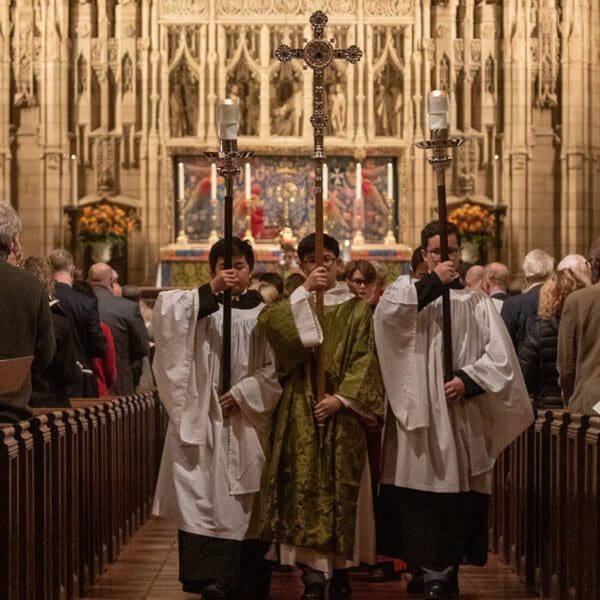
The Seventh Sunday of Easter is also called The Sunday after Ascension Day. Because Ascension Day is always the 40th Day of Easter and Pentecost is always the 50th Day, The Sunday after Ascension Day is always the Sunday preceding Pentecost. So it is always the last Sunday in the Easter season. We offer services at 8am and 9am, a Festal Eucharist at 11am, and a Festal Evensong (which includes the final sermon in the series on prayer) at 4pm.
These last 10 days of Eastertide are called Ascensiontide, the period of time after Christ ascended to the Father, yet before the coming of the Spirit. It, therefore, was a time of waiting, yet with much to do. Not unlike the way we live now...though we have the Spirit ever with us.
There are some sermons in the archive that can help you understand all of this. Consider these sermons from the Rector:
A Sermon for Ascensiontide (2009)
God's Cloud and Fire (2003)
Looking Back: Ascension Day (webcast still available)
We offered services at 8am or 12:10pm in the Chantry Chapel, or for a choral Festal Eucharist at 5:30pm on Ascension Day, May 17. Although on Ascension Day we marked the Lord's physical departure from us, he does not abandon us. He remains present with us in the Sacrament, and we celebrate the coming of the Spirit just 10 days later on the Day of Pentecost. Still, on this day at 5:30pm, we commemorated his ascension by extinguishing the Paschal Candle, where it had been burning since Easter Vigil.
He Ascended into Heaven (2011) by Fr Spurlock
Ascension Day Greetings (2010) by Fr Mead
A Presence within an Absence (2008) by Fr Austin
The Ascension, the Church, and the World (2006) by Fr Austin
The Ascension: Christ Fills All Things (2002) by Fr Mead
Looking Back: Rogation Days (May 14-16)
To learn about Rogation Days, consider listening to this Rector's Weekly Message from 2011. Many people joined us for worship services in the Chantry Chapel on Monday, Tuesday and Wednesday.
That we should remember to be thankful for, and good stewards of, the earth on these three days before Ascension Day makes a good deal of sense. After all, on Ascension Day we commemorate Christ's ascent to the right hand of the Father, thereby leaving us to go forth throughout the world, and (among other things) to care for the world.
So Rogation Days remind us of our placement in time and space, and prepare us for the physical absence of Christ, who will come again, but who for the present moment is not with us in the way he once was. He has sent the Comforter to guide us in our work, and Christ remains with in the Eucharist, and the Father provides all we need (and the Father and Christ remain accessible to us through prayer). Yet, the work we have been given is for us to do, and this work is very much tied to our lives as physical creatures in time and space. Therefore, by reminding us of our earthly responsibilities, Ascension Day, and these Rogation Days leading up to Ascension Day, ground us.Looking Back: The Fifth & Sixth Sundays of Easter (webcasts still available)
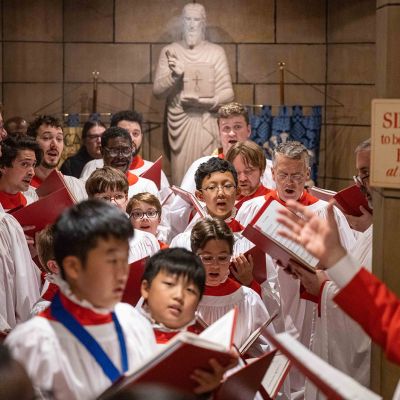
Our full choir of Men and Boys sang at 11am and 4pm on both Sunday, May 6 and Sunday, May 13.
On the Fifth Sunday of Easter (May 6), we welcomed Bishop Sisk for his last Confirmation visitation to Saint Thomas as Bishop of New York (he intends to retire in February 2013). At 11am, he laid his hands on 27 new Episcopalians (25 are being confirmed, and 2 are being received). If you would like to be confirmed or received into the Episcopal Church next year, don’t hesitate to let us know.
At 4pm Festal Evensong on May 6, we presented a rare opportunity to hear William Byrd’s Great Service. Byrd’s four service settings range in style from the unpretentious Short Service (sung at Choral Evensong on Tuesday, May 8) to the magnificent so-called Great Service, a grandiose work which continues a tradition of opulent settings by Richard Farrant, John Sheppard, William Mundy and Robert Parsons. Byrd’s setting is on a massive scale, requiring five-part Decani and Cantoris groupings in antiphony, block homophony and sections with verse (solo) sections for added variety. The sheer scope of the work and the lavish scoring suggest that Byrd probably composed it for the Choir of Chapel Royal.
On the Sixth Sunday of Easter (May 13), we offered another opportunity to hear music not often sung at Saint Thomas. This is because the 11am service included Choral Mattins, which occurs only three times a year at Saint Thomas. Mattins allows us to offer some extraordinary works of the Anglican Choral tradition that our choir normally does not have the opportunity to sing, including a setting of the Te Deum and Jubilate. This time around, we had Stanford’s Te Deum in C, and Britten’s Jubilate in C.
On May 13 we also welcomed back the Very Reverend John R. Hall, Dean of Westminster Abbey. Dean Hall preached at 11am, but this is was not the only opportunity to see him and hear from him. Earlier in the week, on Tuesday, May 8, he gave a free lecture at Saint Thomas at 6:30pm about Westminster Abbey and its centuries-old setting for royal celebrations. There was a little wedding there, you might recall, about a year ago with a certain Will and a lovely Kate.
May 6 and May 13 also featured two installments in our popular sermon series on the topic of prayer. On May 6, Fr Spurlock took up two types of prayer: intercession and petition. Then, on May 13, the Rector returned us to the Lord’s Prayer with a meditation on the phrase, “deliver us from evil.” The series on prayer wraps up on May 20 with a sermon by Fr Austin.
Looking Back: The Third Sunday of Easter (webcasts still available)
Our full choir of Men and Boys are now back from their Easter break and sang at 11am and 4pm on Sunday, April 22.During Eastertide, we continue to make our way through the resurrection appearances of Christ in the Gospels, specifically in Saint Luke, since this is "Year C" in the church lectionary. [Year A focuses on Matthew, Year B on Mark, Year C on Luke, and John infuses all three years; thus, every three years we make our way through all four Gospels on Sundays]. These resurrection appearances raise an interesting question: what are we to make of Christ's resurrected "body?"
The Word was made flesh. Does it stay that way (in the flesh) through the resurrection? Through the ascension? Yes indeed, it appears, but the resurrected Christ has a transformed body which is much more than our own. Yet, as we hear in this Sunday's Gospel, Christ's resurrrected body seems very worldly (not simply some ghostly figure), for he eats fish and honeycomb (not the honeycomb pictured at right!) in front of his disciples.
To those who are interested in how the incarnation plays itself out through the resurrection, consider the Rector's weekly audio message, which this week focuses on precisely this topic. You might also find these three sermons by the Rector helpful:
For John Updike (2009)
The Name and Power of Jesus (2006)
Physical Faith (2003)
The sermon at 11am on Sunday, April 22 was NOT be delivered by the Rector, so we got someone else's take on the matter! It was delivered by our friend Dean Willis of Canterbury Cathedral (pictured at left), who was back in town. How privileged we are that he pays a visit to Saint Thomas so often when he is in our city. Nevertheless, there was indeed be a Mead preaching on Sunday the 22nd: at 4pm the sermon series on prayer continued with a sermon by a visiting preacher, who just happens to be our Rector's son, Matthew Mead.
Looking Back: The Feast of Saint Mark (webcast still available)
We remembered Saint Mark three times on April 25, at 8am and 12:10pm in the Chantry Chapel, and with a full-blown Festal Eucharist at 5:30pm with the Saint Thomas Choir of Men and Boys at the High Altar.
Although the Feast of Saint Mark is a Major Feast (and hence you see it listed on the website calendar in capital red letters), in Lesser Feasts and Fasts there is a good summary of Saint Mark:
A disciple of Jesus, named Mark, appears in several places in the New Testament. If all references to Mark can be accepted as referring to the same person, we learn that he was the son of a woman who owned a house in Jerusalem, perhaps the same house in which Jesus ate the Last Supper with his disciples. Mark may have been the young man who fled naked when Jesus was arrested in the Garden of Gethsemane. In his letter to the Colossians, Paul refers to “Mark the cousin of Barnabas,” who was with him in his imprisonment. Mark set out with Paul and Barnabas on their first missionary journey, but he turned back for reasons which failed to satisfy Paul (Acts 15:36-40). When another journey was planned, Paul refused to have Mark with him. Instead, Mark went with Barnabas to Cyprus. The breach between Paul and Mark was later healed, and Mark became one of Paul’s companions in Rome, as well as a close friend of Peter’s.
An early tradition recorded by Papias, Bishop of Hieropolis in Asia Minor at the beginning of the second century, names Mark as the author of the Gospel bearing his name. This tradition, which holds that Mark drew his information from the teaching of Peter, is generally accepted. In his First Letter, Peter refers to “my son Mark,” which shows a close relationship between the two men (1 Peter 5:13).
The Church of Alexandria in Egypt claimed Mark as its first bishop and most illustrious martyr, and the great Church of St. Mark in Venice commemorates the disciple who progressed from turning back while on a missionary journey with Paul and Barnabas to proclaiming in his Gospel Jesus of Nazareth as Son of God, and bearing witness to that faith in his later life as friend and companion to the apostles Peter and Paul.
For more about Saint Mark, see these two sermons by the Rector. Although they are both from the season of Advent, they are ever-relevant (and insightful regarding Mark):
Preparing the Way (2002)
At right: The reredos of Saint Thomas Church places the four Evangelists to the left and right of the empty cross. Matthew and Mark (pictured above) are to the left of St Peter (who is immediately to the left of the cross), and Luke and John are to the right of St Paul (who is immediately to the right of the cross). The words inscribed on the scroll in Mark's hand are written in Greek, and can be translated "the Gospel according to Mark." Read more about Mark by clicking on the red words above the picture.
Looking Back: The Second Sunday of Easter (webcasts still available)
As our choir was on break on April 15, we were pleased to welcome visiting choirs to sing at our services on The Second Sunday of Easter. At 11am, members of the Rodolfus Choir were our guests from the United Kingdom, and at 4pm we welcomed back TENET, a choral group based here in New York City. The Second Sunday of Easter also included the resumption of our fifteen part sermon series on prayer. The entire series can be found here.This scene is displayed immediately above the high altar of Saint Thomas Church, wherein you can see Thomas kneeling on one knee making his confession of faith before Our Lord, surrounded by the other disciples. [pictured above at left]
& Easter Services?
the webcasts for individual services.
April 1: The Sunday of the Passion (Palm Sunday)
8am The Blessing of the Palms (said)
9am The Palm Sunday Liturgy &
The Blessing of the Palms
11am The Blessing of the Palms &
Solemn Eucharist of the Passion
4pm Solemn Evensong
April 2: Holy Monday
8am Morning Prayer & Mass
12:10pm Solemn Eucharist
5:30pm Evening Prayer & Mass
6:30pm Musical Meditation: Organ
April 3: Holy Tuesday
8am Morning Prayer & Mass
12:10pm Solemn Eucharist
5:30pm Evening Prayer & Mass
6:30pm Musical Meditation: Vocalists & Instrumentalists
April 4: Holy Wednesday
8am Morning Prayer & Mass
12:10pm Solemn Eucharist
5:30pm The Office of Tenebrae
April 5: Maundy Thursday
12:10pm Solemn Eucharist
5:30pm The Solemn Liturgy of Maundy Thursday
April 6: Good Friday
12noon The Three Hours Devotion
5:30pm The Solemn Liturgy
of Good Friday
April 7: Holy Saturday
5:30pm The Great Vigil &
First Eucharist of Easter
April 8: The Sunday of the
Resurrection (Easter Day)
8am Solemn Eucharist of the
Resurrection
11am Solemn Eucharist of the
Resurrection
2:30pm Organ Recital
3pm Solemn Evensong